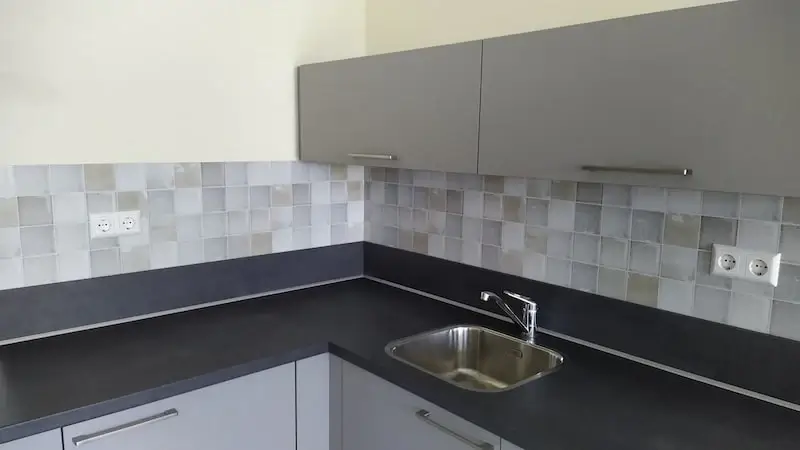
Tiles behind the worktop are the classic kitchen wall, and for good reason: a tile pattern gives a kitchen character in a way few other materials can. The catch is that a tiled wall is also a job. The old tiles come off, a tiler comes in, there are days of dust, and after that come years of scrubbing grout behind the cooker. This article shows how to keep the tiles and skip the work, which tile style suits which kitchen, and where to find all 99 tile designs in our collection.
Real tiles or one panel with a tile look?
A kitchen backsplash with a tile look is one made to measure panel, printed with a tile pattern. You see tiles and grout lines, but the wall itself is smooth and seamless. The difference from a real tiled wall is not in how it looks, but in everything around it.
| Real tiles | Panel with a tile look | |
|---|---|---|
| Grout | Metres of grout per square metre, porous | None, the grout lines are part of the print |
| Fitting | A tiler, adhesive, grouting, curing time | Fit it yourself with mounting adhesive |
| Old tiles | Chip them off first or tile over them with a thick layer | Stay where they are, the panel goes over them |
| Sockets | Tiles cut to size | Cut-outs made in advance or by you |
| Cleaning | Grout attracts grease and limescale | A damp cloth |
| Where real tiles win | Genuine relief and a glaze you can feel | Up close you can see it is flat |
That last row is there to be honest. With your nose against the wall, you can tell a printed tile is flat. From a normal distance it reads as tiling, and what you get in return is a wall without a single grout line to keep clean. Behind a hob and a sink, that is the difference between a wall that still looks new after five years and one with a grey haze around the cooking zone.
Tiles above the worktop
The strip between the worktop and the wall cabinets is usually 50 to 65 centimetres high. That is exactly where tiles take the most punishment: splashes from the pan, water from the tap, grease rising from the hob. It is also where a tile pattern stands out most, because you look at it all day.
If you want a whole kitchen wall rather than a strip, up to the ceiling or around a window, it works the same way. We make the panel to your measurements, so it makes no difference whether it is 60 centimetres or a wall three metres wide. On a large wall the design can run across several panels, so the pattern lines up.
Every tile style at a glance
Our collection has 99 tile designs, spread across a few categories on the site. Below they are grouped by style, with every design listed under each style, so you do not have to search through six collections.
Herringbone
Herringbone is the tile we were asked for most over the past year, and it suits almost any kitchen. Grey and beige keep it calm, glazed green or blue turns it into a statement. The grey herringbone tile with a travertine look is our most viewed tile design, and the beige version is its warm counterpart. We wrote a separate article on herringbone backsplashes about the difference between herringbone, chevron and basketweave.
All herringbone designs: grey travertine, beige travertine, white glazed, grey glazed, golden brown, blue green, sea green, turquoise, white marble and wide white marble tiles.
Basketweave
A relative of herringbone, but with tiles laid in small blocks at right angles to each other. It looks woven and is a little calmer than herringbone. All designs: grey, golden brown, turquoise and blue.
Metro tiles
The elongated tile in a running bond, familiar from the metro stations of Paris and the New York subway, which is why they are also called subway tiles. They are timeless and work best when you let the colour do the talking: off-white for a light kitchen, deep petrol or navy for a kitchen with wooden fronts or brass taps. The tiles with a weathered glaze give the handmade effect that real metro tiles have too.
All metro tiles: light grey, sand coloured limestone, olive green and smoke grey, cobalt and turquoise, navy and petrol. The same tiles mixed with decorative tiles: grey, navy and petrol. Elongated, but in natural stone: white marble and slate.
Zellige and glazed tiles
Small square tiles with a glaze that comes out slightly differently on each tile, like the handmade zellige from Morocco. From a distance a calm surface in one colour, up close full of life. This is the tile for anyone who wants colour without a pattern. You will find them in the antique tile collection, and the most popular colours are sea green Opal and ochre brown Roti.
All colours: Opal, Roti, Swirl, Black Haze, Ghost, Lemon Ginger, Nebula, Straw, Green Teal, Mystic, Star Dust, Polo Blue and White Lilac.
Antique tiles with a motif
The same cream white tiles, but with a painted motif that runs across several tiles: fish, lemons, chickens. It works like a tile mural and gives a country kitchen a story. Where these motifs come from and how to combine them is covered in antique tile designs on your kitchen backsplash.
All motifs: fish, lemons, toucan, pineapple, vegetables, blossom, grey chickens, colourful chickens and wild flowers.
Delft blue and Old Dutch tiles
Blue on white, with ships, windmills and little figures. The Old Dutch tile is one of the most searched for tiles for the kitchen, and it fits surprisingly well in a modern kitchen, as long as everything else stays calm. The Old Dutch tiles DW3314 are a patchwork of different tiles, while the original Delft blue DW3315 sticks to one kind. You can see how a customer paired DW3314 with a pink wall in Delft blue tiles in the kitchen.
All designs: Old Dutch patchwork, Delft blue figures, Delft blue birds, Old Dutch in sepia and weathered blue and white tiles.
Portuguese tiles and azulejo patchwork
Tiles with a geometric or floral pattern, often in a patchwork of different designs side by side. Blue and white is the classic, but there are also versions in orange, grey and red. They look good in a kitchen with wood and terracotta, and just as good outdoors as indoors. The Portuguese tile Feldspar is the bestseller here. You can read more about the history of these tiles in Portuguese tiles in the interior, and for outdoors there is the outdoor kitchen with a Portuguese tile look.
All designs: Feldspar, Star Dust in grey, blue and white patchwork, colourful azulejo, blue, Mandela, red and turquoise patchwork, beige and blue patchwork, light blue floral tiles and weathered tiles on plaster.
Cement tiles and weathered decorative tiles
Decorative tiles with a lived-in look, as if they have been lying in a French country house for a hundred years. Muted colours, faded ornaments, the odd chip here and there. This is the tile for a kitchen that does not want to look new. The green decorative tiles and the grey damask tile are the most viewed.
All designs: green, brown, grey, grey damask, cream damask, weathered floral tiles, Moroccan design tiles, industrial concrete tiles with decorative tiles and rust and copper.
Moroccan diamond tiles
Tiles in an arabesque diamond pattern, with the glow of stained glass. Bold and colourful, so they look best in a kitchen that is otherwise plain. Three colourways: green and turquoise, beige and ochre and grey and olive.
Hexagon and geometric tiles
Hexagonal tiles instantly give a kitchen a graphic feel, and with a printed hexagon the grout lines always run perfectly. In a concrete look for a rugged, industrial kitchen, in marble for something more luxurious. The hexagon concrete mix runs from light to dark and is the most popular.
All designs: hexagon concrete mix, light hexagon concrete, dark hexagon concrete, cream honeycomb mosaic, elongated marble hexagon, marble diamond tiles, pastel hexagon patchwork, grey diamond tiles with relief and 3D concrete tiles with triangles.
Mosaic
Small stones or shards instead of tiles. Mosaic brings plenty of texture and works best on a smaller wall, otherwise it gets busy. All designs: white marble strips, grouted marble strips, grey and gold marble mosaic, blue glass mosaic, fine mosaic in pastel, mosaic with flowers and Park Güell, after Gaudí’s broken tile mosaic in Barcelona.
Natural stone, marble and industrial tiles
Large tiles in stone or metal, more like surfaces than a pattern. They suit a modern kitchen with a sturdy worktop. All designs: black marble, weathered stone tiles, blue green natural stone and blue green industrial. If you are looking for marble without a tile pattern, take a look at the marble collection.
Tiles on old plasterwork
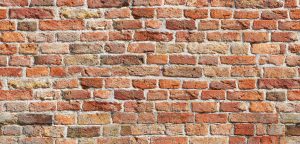
A wall where the plaster has flaked away to reveal old tiles underneath. A mix of tile, plaster and sometimes brick, and the tile look with the most character we have. All designs: mosaic, plaster and tile, green and ochre decorative tiles on plaster, blue tiles with brick and brick and tile patchwork. If brick is what you are really after, read brick in the kitchen without grout.
Retro
Tiles from the seventies, with big flowers and rounded shapes. The retro floral tile in green and orange is our only true seventies design. You can also combine it with antique tiles, which is what retro tiles in the kitchen is about.
Which tile for which kitchen
- White, sleek kitchen. Herringbone or metro tiles in grey or white add structure without making it busy. If you want colour, choose a single colour of zellige.
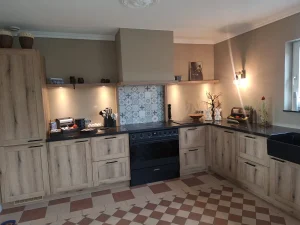
- Wooden fronts or an oak worktop. Warm sandy beige, ochre or a terracotta coloured Portuguese tile. Blue and green work too, they contrast nicely with wood.
- Green kitchen. A green tile in a slightly different shade, or cream white with a motif instead. The green decorative tiles and the sea green herringbone are the obvious choices here.
- Black or anthracite kitchen. Light tiles make it feel more airy: white marble, off-white or light grey.
- Country kitchen. Delft blue, antique tiles with a motif or weathered cement tiles.
- Industrial kitchen. Hexagon in a concrete look, slate or tiles on old plasterwork.
Not sure about the colour? Order samples. On a 20 by 20 cm sample you see the design as it really is, and you can hold it up against your kitchen fronts. A screen always shows colour slightly differently from print, which is why a sample in your own kitchen light tells you more than any photo.
Large tiles or small tiles
With a real tile you choose a size and you are stuck with it. With a printed tile you are not: we scale the design to your wall. Large tiles make a kitchen wall calm and help a small kitchen look bigger, small tiles give more detail and suit a country or vintage style. When scaling, we also make sure the pattern finishes neatly at the edges, so you do not end up with half a tile in the corner. Let us know when you order if you have a particular size in mind.
Straight over your existing tiles
This is why most people choose a tile look. The old tiles do not have to come off: the panel goes over them with mounting adhesive. The wall does need to be flat and the tiles firmly attached. Fix any loose tiles first, and level out a bulging wall or deep, uneven grout lines. Holes from old wall plugs are no problem, they disappear behind the panel.
You fix it with mounting adhesive, not double-sided tape. You can make the cut-outs for sockets yourself or have us make them. How to go about it step by step is explained in fitting and mounting a kitchen backsplash. Measure carefully first, because the panel is made to measure: this is how to measure your kitchen wall.
Which material for a tile look
For most kitchens DW Original is the best choice: light, affordable and with a sharp print. If you cook on gas, we recommend solid aluminium or tempered glass behind the cooking zone. Glass also gives a tile design depth and shine, which works well with glazed tiles. All the differences are on the compare materials page.
What a tile look costs depends on the size and the material, not on the design. So a herringbone costs the same as a plain colour. A worked example for each material is in what does a kitchen backsplash cost.
Frequently asked questions
Can a tile look backsplash go over my current tiles?
Yes, that is the most popular option. The panel goes over the existing tiles with mounting adhesive, provided the wall is flat and the tiles are firmly attached. You do not need a tiler or any demolition work.
Can you tell they are not real tiles?
From very close up you can see the wall is flat. From a normal distance the tiles and grout lines read as real tiling. Where you really notice the difference is when cleaning: there is no grout to soak up grease or limescale.
Can I change the size of the tiles?
Yes. We scale every tile design to your wall, larger or smaller, and make sure the pattern finishes neatly at the edges. Let us know when you order if you want a particular tile size.
Can a tile look go behind a gas cooker?
Behind induction and ceramic hobs our standard material is perfectly fine. If you cook on gas, we recommend glass or solid aluminium behind the cooking zone, because that is where direct heat from the flames reaches the wall. The tile design simply carries on across both parts.
How do I clean a tile look backsplash?
With a damp cloth and an ordinary all-purpose cleaner. Do not use abrasive cleaners or scouring pads, as they will dull the surface over time. Because there are no grout lines, there is nowhere for dirt to collect.
Can I order a sample of a tile design?
Yes, every design is available as a 20 by 20 cm sample. That way you see the colour and the print as they really are, next to your own kitchen fronts.
Getting started
Choose a style above, or browse the antique tiles, concrete, tiles and stone and patterns and stripes collections. Want to see how a tile looks in your kitchen first? Request a free simulation with a photo of your kitchen. And if you want the full picture, from material to fitting, read the complete guide to kitchen backsplashes.
Choose your tile look, we make it to measure
One panel over your existing tiles, without grout lines. Choose a design from these collections or order a sample first.