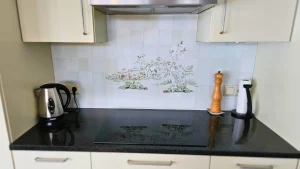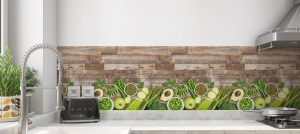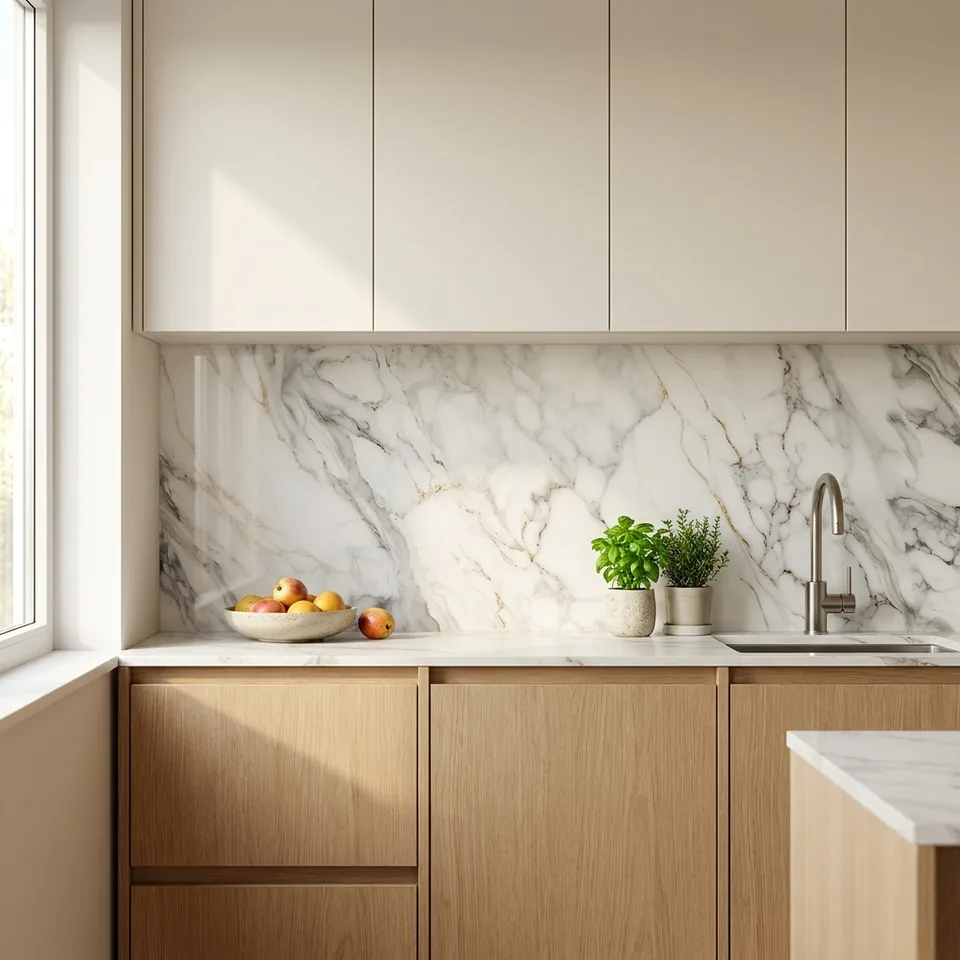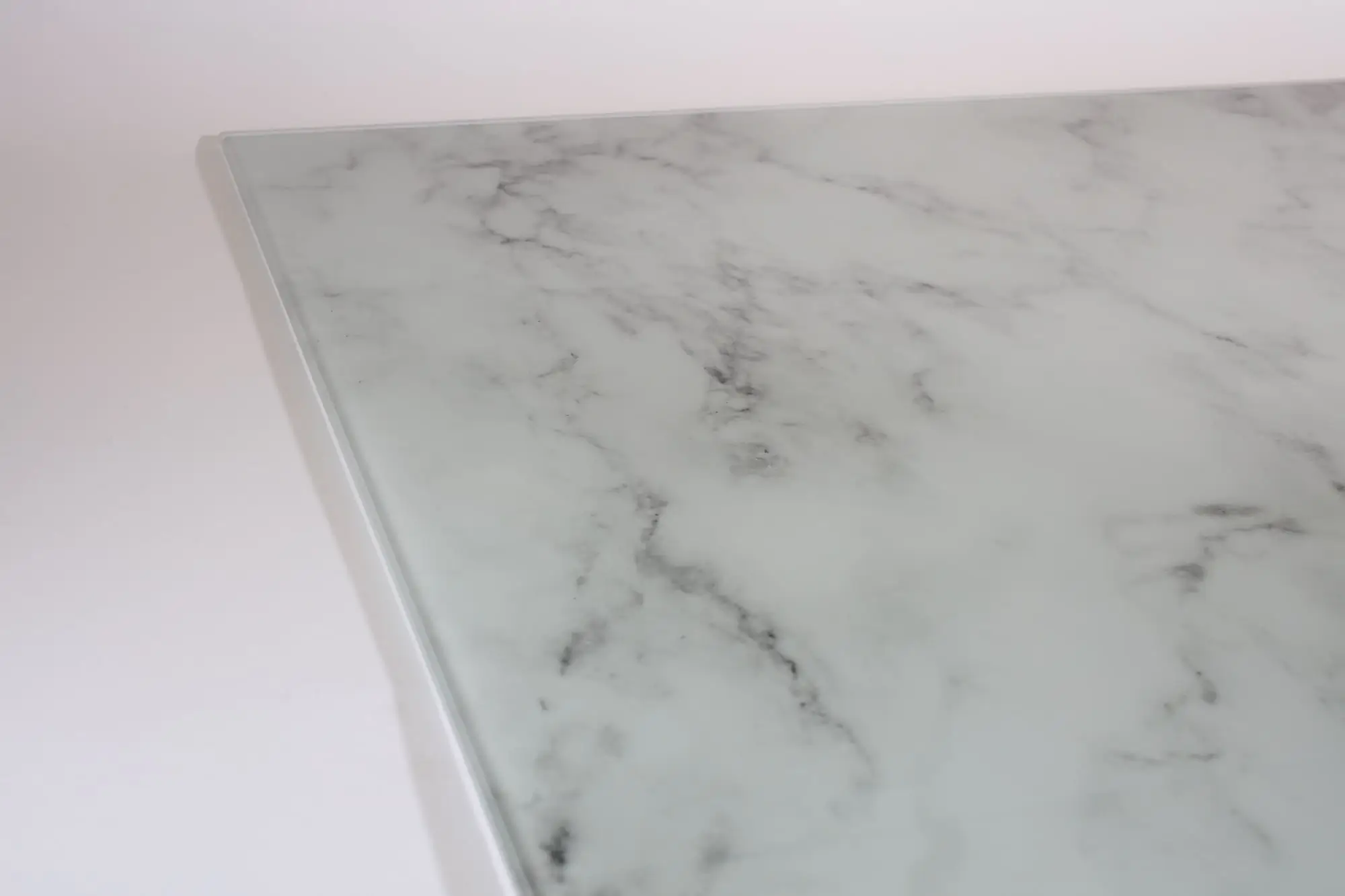
A backsplash of 6 mm toughened safety glass, heat resistant to 250 °C, with a choice of 500+ designs or your own photo. Why more and more kitchens go for a made to measure glass backsplash, and when another material is the smarter call.
Contents
- Why toughened glass is the premium material
- What exactly is toughened glass?
- Advantages of a glass backsplash
- The drawbacks, honestly
- DW Glass vs. the competition
- A glass backsplash behind a gas hob
- Glass vs. tiles vs. aluminium
- Price and cost factors
- Fitting a glass backsplash
- Maintenance and cleaning
- Frequently asked questions
- Putting your glass backsplash together
Why toughened glass is the premium material for your kitchen backsplash
A glass backsplash in the kitchen is not simply a trend. It is a deliberate choice for the material that combines visual impact, hygiene and durability. Where tiles have grout that discolours and laminate fades after a few years, toughened glass keeps its original appearance for decades.
At Designerwand we work with DW Glass: a glass backsplash of 6 mm toughened safety glass, printed on the back and made to measure down to the millimetre. The result is a depth and gloss you will not find in any other material.
- 6 mm toughened safety glass (4 mm for smaller decorative applications)
- 250 °C heat resistant
- 500+ designs, or your own photo
- €550 per m² for a made to measure glass panel
In this guide we cover everything you need to know about a toughened glass backsplash: from the production process and the safety characteristics to prices, installation and maintenance. Whether you are renovating your kitchen or having a completely new one fitted, after this article you will know whether a glass backsplash suits your situation. In the meantime, feel free to browse the full backsplash collection.
What exactly is toughened glass?
Toughened glass, also called tempered safety glass or ESG glass, is glass that has been through a thermal hardening process. That makes it four to five times stronger than ordinary float glass of the same thickness.
The production process in three steps
- Cutting and machining. The glass is first cut to size and all machining (holes, cut outs) is carried out. This is a crucial point: once toughened, the glass can no longer be cut or drilled.
- Heating. The glass goes into a furnace at around 620 °C, just below melting point. At that temperature the internal structure is redistributed.
- Rapid cooling. Straight afterwards the glass is cooled quickly and evenly with powerful jets of air. The outer layers cool faster than the core, which creates permanent compressive stress in the surface.
Why that compressive stress matters. The stress in the surface means the glass withstands far more force before it breaks. And if it does break, it falls apart into small, relatively blunt granules rather than large shards. That is precisely what makes toughened glass a safety glass. DW Glass meets all applicable safety glass standards.
Toughened glass vs. ordinary glass
| Property | Ordinary float glass | Toughened safety glass |
|---|---|---|
| Strength | Baseline | 4 to 5x stronger |
| Heat resistance | Limited | Up to around 250 °C |
| Breakage behaviour | Large, sharp shards | Small, blunt granules |
| Machining afterwards | Yes (cutting, drilling) | No, only before toughening |
| Safety classification | None | Meets all applicable safety glass standards |
On DW Glass backsplashes the print sits on the back of the glass. Your print is therefore protected by the full thickness of the pane. You never touch it directly, which rules out discolouration or damage from cleaning.
7 advantages of a glass backsplash in the kitchen
A made to measure glass backsplash offers advantages you will not find in this combination in any other material.
1. Spectacular depth and gloss
The greatest visual advantage of glass is its depth. Because the print sits behind the glass, you look at your design through a transparent layer. That gives a three dimensional effect that a print on aluminium or composite cannot match. With marble patterns and natural stone designs the difference is striking.
2. Completely hygienic
Glass is non porous by nature. Bacteria, mould and odours get no chance to settle into the material. There is no grout for dirt to collect in, as there is with tiles. That makes a glass backsplash ideal for the zone behind your hob and worktop.
3. Heat resistant to 250 °C
Toughened glass withstands temperatures up to around 250 °C. That is more than enough for use directly behind a gas hob or an induction hob. For comparison: the flame of a gas hob gets extremely hot, but during normal cooking the wall behind it rarely gets warmer than 80 to 100 °C.
4. Made to measure to the millimetre
Every DW Glass backsplash is produced to size. You enter your exact dimensions, including cut outs for sockets, and receive a panel that fits seamlessly. No sawing, no joins.
5. 500+ designs or your own photo
Choose from more than 500 designs in categories such as marble, concrete and natural stone, botanical and abstract. Or upload your own photo. With the free simulation service you see in advance how the design looks in your kitchen.
6. Easy maintenance
You clean a glass backsplash with ordinary glass cleaner and a microfibre cloth. Grease spatter, sauce marks and limescale come off effortlessly. No special products needed, no grout to treat separately.
7. Long service life
Toughened glass does not discolour under UV light, does not warp in the heat and does not wear from cleaning. The print sits protected behind the glass, so it does not fade either. Under normal use a glass backsplash lasts for decades without trouble.
Drawbacks of a glass kitchen backsplash
Honesty lasts longest. A toughened glass backsplash is not the best choice in every situation.
Advantages in short
- Unique depth and gloss
- Hygienic, non porous and grout free
- Heat resistant to 250 °C
- Made to measure to the millimetre
- 500+ designs or your own photo
- Minimal maintenance and a long service life
Drawbacks worth knowing
- Heavier than aluminium or composite panels
- Higher purchase price than budget materials
- Cannot be machined after production
- Careful measuring is essential
- Fingerprints show up more than on a matt material
Weight and transport
Toughened glass weighs roughly 2.5 kg per m² per millimetre of thickness. A 6 mm panel therefore comes to around 15 kg per m². For a typical panel of 200 x 60 cm that means some 18 kg. Two people lift that comfortably, but it is the heaviest of our three materials: DW Solid in 1.5 mm solid aluminium stays around 4 kg per m².
Price vs. quality
A glass backsplash costs more than a basic composite panel or standard tiles. You are paying for a material that does not discolour, does not warp and lasts for decades. Counted per year, toughened glass often works out cheaper than a less expensive alternative you replace after five to seven years.
Accurate measuring is crucial
Because toughened glass can no longer be cut or drilled after production, accurate measuring is essential. Measure several times and allow for irregularities in the wall. In doubt? Read the installation guide or get in touch for advice.
DW Glass vs. the competition: why Designerwand?
There are several suppliers of glass backsplashes. What makes DW Glass by Designerwand different?
- 500+ ready made designs
- You can upload your own photo too
- Free simulation service
- An online calculator that shows the price straight away
- Made to measure to the millimetre, including cut outs for sockets
- Three materials side by side: Glass, Solid and Original
- Samples available
- A showroom in Veenendaal to see everything next to each other
The simulation service: see it before you buy
Designerwand’s strongest advantage is the free simulation service. Send a photo of your kitchen, choose a design, and we show you a realistic rendering of how the backsplash will look in your own room. That way you order with confidence.
Three materials, one shop
Not sure whether glass is the right material? You can order the same design in solid aluminium (DW Solid) or DW Original as well. That way you compare the materials and choose what suits your kitchen and budget.
Ordering samples. Would you like to see and feel the material for real first? Order a sample of your favourite design and judge colour, texture and the way the light falls in your own kitchen.
A glass backsplash behind a gas hob: is that safe?
This is one of the most frequently asked questions about a glass backsplash behind the hob. The short answer: yes, toughened glass is safe behind a gas hob. Here is the reasoning.
Temperatures in practice
The flame of a gas hob gets many hundreds of degrees hot. The wall behind it does not. In normal cooking use, the temperature of a kitchen backsplash rarely rises above 80 to 100 °C, even with several burners going.
DW Glass is heat resistant to around 250 °C. That is a margin of more than 150 °C over what the wall actually reaches in practice.
Safety requirements
Keep a minimum distance between hob and backsplash. Gas hob manufacturers specify that distance in the appliance manual. Always check the specifications of your own hob. There is more on this in our article about backsplashes with a gas hob.
Why toughened glass beats ordinary glass behind a hob
Never use ordinary glass behind a hob. Ordinary float glass can crack from thermal stress at even a modest temperature difference. Toughened glass tolerates far greater temperature swings and is therefore suitable for the zone behind a hob.
Do you have an induction hob rather than gas? Then the wall temperature stays lower still, because induction generates the heat directly in the pan and not through an open flame. A glass backsplash is an excellent choice in that case.
Glass backsplash vs. tiles vs. aluminium
Three popular materials side by side. Which suits your kitchen best?
| Property | Toughened glass (DW Glass) | Tiles | Aluminium (DW Solid) |
|---|---|---|---|
| Thickness | 6 mm | Around 8 mm plus adhesive | 1.5 mm solid aluminium |
| Depth effect | Very strong, print behind glass | Flat | Matt and subtle |
| Heat resistance | Up to around 250 °C | Very high | Very high |
| Grout | None | A lot | None |
| Maintenance | Glass cleaner | Cleaning and renewing grout | Glass cleaner |
| Design choice | 500+ designs or your own photo | Limited to tile patterns | 500+ designs or your own photo |
| Made to measure | To the millimetre | Cut on site | To the millimetre, max 300 x 146 cm |
| Installation | 1 to 2 hours, bonded | 1 to 2 days, including grouting | 1 to 2 hours, bonded |
| Weight per m² | Around 15 kg | Tiles plus adhesive and grout | Around 4 kg |
| Price per m² at Designerwand | €550 | Not in our range | €425 |
When to choose glass
Choose a glass backsplash if you want maximum visual impact. The depth and gloss of glass are unmatched. Ideal for modern, sleek kitchens and for anyone who loves marble, natural stone or art behind glass.
When to choose aluminium
Choose DW Solid if weight matters, for instance with large panels or a wall with less load bearing capacity. Aluminium gives a more matt, subtle look and copes excellently with heat.
When to choose tiles
Tiles are a good choice over a small area on a limited budget, or if you specifically want the look of relief tiles or handmade tiles. Bear the grout maintenance in mind. Looking for the tile look without the grout? Have a look at the backsplash collection, where the tile design sits on a seamless panel.
Glass kitchen backsplash price: what to expect
The price of a made to measure glass backsplash depends on a handful of factors. Here is the honest overview.
What determines the price?
- Dimensions. The surface area in square metres is by far the biggest factor. DW Glass costs €550 per m², with a minimum of 20 x 20 cm.
- Cut outs. Cut outs for sockets or switches have to be made before toughening. With cut outs the rate becomes €595 per m².
- Material. DW Glass €550 per m², DW Solid €425 per m² and DW Original €270 per m².
- Design. All designs from the collection cost the same. With your own photo, image editing may be needed if the resolution falls short.
Price guide DW Glass
| Size (w x h) | Area | Price without cut out | Price with cut out |
|---|---|---|---|
| 100 x 60 cm | 0.60 m² | €330 | €357 |
| 200 x 60 cm | 1.20 m² | €660 | €714 |
| 200 x 90 cm | 1.80 m² | €990 | €1,071 |
| 300 x 60 cm | 1.80 m² | €990 | €1,071 |
See your own price straight away. Enter your exact dimensions on the DW Glass page and the calculator works it out immediately. No quote needed.
Glass vs. tiles: the hidden costs
At first glance tiles look cheaper. Count the total cost: tile adhesive, grout, the hours of a tiler and the periodic renewal of grout lines. A glass backsplash is bonded in one to two hours and has no maintenance costs after that. Over ten years the comparison often looks rather different from what the receipt suggests.
Fitting a glass backsplash: step by step
With the right preparation you can fit a glass backsplash yourself in one to two hours. Would you rather not do it yourself? A local handyman is usually the most affordable option, and we are also happy to prepare an installation quote: all we need is your postcode.
- Measuring. Measure width and height at several points. Note the smallest measurement if your wall is not completely straight, and mark the position of sockets accurately. More on this in the installation guide.
- Preparing the wall. The wall must be clean, dry and flat. Remove old tiles or wallpaper where needed and fill any irregularities. A flat substrate determines the end result.
- Bonding. Apply adhesive to the back in vertical strips about 3 cm wide, 15 to 20 cm apart. Use an adhesive suitable for glass: neutral curing, not acidic.
- Placing and aligning. Press the panel on evenly. Use spacers at the bottom if you want a few millimetres of clearance between worktop and panel. Check with a spirit level.
- Finishing. Seal the edges with transparent silicone. Let the adhesive cure for at least 24 hours before using the kitchen intensively.
Important. Toughened glass cannot be cut or drilled after production. Check your dimensions and cut outs before you order. Unsure about measuring? Get in touch with our team.
Besides bonding there are other fixing options: an invisible plastic hanging system, an aluminium hanging system, or laser cut holes with stainless steel spacers for a floating effect.
Maintenance and cleaning of a glass backsplash
One of the biggest advantages of a toughened glass backsplash is how little maintenance it needs.
Daily care
A quick wipe with a damp microfibre cloth after cooking is enough. Grease spatter and sauce marks release straight away from the smooth, non porous glass. Special cleaning products are unnecessary.
Weekly, or for stubborn marks
Spray ordinary glass cleaner onto the surface and wipe dry with a clean microfibre cloth or a squeegee. Work from top to bottom to avoid streaks.
What to avoid
- Abrasives and scouring pads. They cause micro scratches in the glass surface.
- Acidic cleaning products. Strongly acidic products can affect the gloss over time.
- Razor blades and metal scrapers. Never use metal to remove baked on dirt. Soak it loose first with warm soapy water.
Against limescale. Do you live in a hard water area? Mix equal parts water and cleaning vinegar, spray onto the marks, leave for five minutes and wipe dry.
Maintenance compared
| Material | Daily | Periodic | Watch out for |
|---|---|---|---|
| Toughened glass | Damp cloth | Glass cleaner | No abrasives |
| Tiles | Damp cloth | Cleaning and renewing grout | Grout discolours and moulds |
| Aluminium | Damp cloth | Glass cleaner | No abrasives |
| Composite or HPL | Damp cloth | Mild detergent | Can discolour from UV and heat |
Frequently asked questions about glass backsplashes
What does a glass kitchen backsplash cost?
DW Glass costs €550 per m², and €595 per m² if cut outs for sockets are needed. A panel of 100 x 60 cm therefore comes to €330, a panel of 200 x 60 cm to €660. Enter your own dimensions on the DW Glass page for an instant calculation.
Is a glass backsplash suitable behind a gas hob?
Yes. DW Glass is 6 mm toughened safety glass that is heat resistant to around 250 °C, while the wall behind a hob rarely exceeds 100 °C during normal cooking. Do keep to the distance your hob manufacturer prescribes. There is more about this on our page about backsplashes with a gas hob.
What is the difference between toughened glass and ordinary glass?
Toughened glass is four to five times stronger than ordinary float glass. It is heated to around 620 °C and then cooled rapidly, which creates permanent compressive stress in the surface. If it does break, it falls apart into small, blunt granules instead of sharp shards. That makes it far safer in a kitchen.
How thick is a Designerwand glass backsplash?
6 mm as standard. That is the best balance between strength, weight and ease of installation. For smaller panels or decorative applications 4 mm is sometimes an option, which we discuss case by case.
Can I have my own photo printed on a glass backsplash?
Yes. The print goes on the back of the glass and is protected by the full thickness of the pane. Use the free simulation service to see in advance how it will look in your kitchen.
Can a glass backsplash go over existing tiles?
Yes, and that is one of the big advantages. The glass panel is mounted straight over your existing tiles, provided they are flat and well bonded. No demolition, so less time, mess and cost.
How do I maintain a glass backsplash?
Minimally. Ordinary glass cleaner and a soft microfibre cloth are enough. Avoid abrasives and scouring pads. Grease spatter lifts off immediately thanks to the non porous surface.
Can I fit a glass backsplash myself?
Yes, with the right preparation fitting it yourself is quite manageable. The usual method is bonding with adhesive onto a clean, flat wall. Allow one to two hours. Have a look at the installation guide for the steps. Would you rather not do it yourself? A local handyman is usually the most affordable option, and we are also happy to prepare an installation quote: all we need is your postcode.
Is a glass backsplash better than tiles?
A glass backsplash has no grout, which makes it more hygienic and easier to keep clean, it goes up faster and it offers far more design choice. Tiles can work out cheaper over a small area but need ongoing grout maintenance. If you want the tile look without the grout, take a look at the backsplash collection.
How long does delivery of a made to measure glass backsplash take?
A DW Glass backsplash has a lead time of 4 weeks, because every panel is made to measure and toughened specially for you. After your order you receive a confirmation with the expected delivery date. The current terms are on the shipping and delivery costs page.
What if my glass backsplash gets damaged?
Toughened glass is four to five times stronger than ordinary glass, so damage is rare. If it does break, it falls apart into small, blunt pieces instead of dangerous shards. Note that toughened glass cannot be cut down afterwards, so you replace the whole panel. Get in touch if you need a replacement.
You will find more answers on our frequently asked questions page.
Putting your glass backsplash together
Choose from 500+ designs or upload your own photo, enter your dimensions and see the price straight away. Produced to measure, down to the millimetre. Have a look at DW Glass, browse the full backsplash collection, or request a free simulation first and see the design in your own kitchen before you spend anything.
Further reading
- 12 kitchen backsplash ideas for every style. Trends and examples, from marble to concrete.
- Fitting a backsplash. Step by step guide to doing it yourself.
- Antique tile designs on your kitchen backsplash. Azulejos, chickens and lemons on a seamless panel.