Concrete in the kitchen stopped being a passing trend years ago. The calm, softly clouded greys work with almost any cabinet front, and unlike an outspoken tile pattern you are unlikely to tire of it. The only question is how to get that look onto your wall. There are two very different routes, and the price gap between them is considerable.
What is beton ciré exactly?
Beton ciré, often written beton cire, is not concrete. It is a thin cement based plaster applied by hand in several layers, then sanded and sealed. The result is a seamless wall with a lively, clouded texture. Beautiful work, and genuinely a craft.
There is a price attached. For a kitchen wall, expect several hundred to well over a thousand euros in labour, depending on the surface area and the plasterer. Add that the wall needs several days to cure, that your kitchen is out of use in the meantime, and that the top layer has to be treated again every few years to stay stain resistant.
For a living room wall that is all manageable. Behind a hob it is a different story, because that is exactly where the wall takes grease, steam and cleaning products.
A printed concrete look panel: what you do and do not get
The second route is a concrete look backsplash made to measure: a panel with a high resolution photograph of a real concrete wall printed on it. We photograph existing concrete surfaces for this, including the hairline cracks, lime marks and colour variation that make it believable.
What you get: the same image, fitted in a day, for a fraction of the price. No curing time, no kitchen out of action, no maintenance round in five years.
What you do not get: relief. A printed panel is smooth. Run your hand across real beton ciré and you feel the texture, and you will not feel that with ours. At eye level in a kitchen you rarely notice, but it is fair to say it.
- Seamless across the full width. No grout lines for grease to soak into, unlike tiles
- Cut to measure, including cutouts for sockets and taps
- Easy to fit yourself, usually with adhesive onto the existing wall
- Stain resistant, cleaned with a cloth and a mild detergent
- Ready straight away, no drying time
White, grey or dark: which concrete look suits your kitchen?
Concrete look is not one colour. The choice decides whether your kitchen reads as more spacious or as warmer.
White concrete look
The most requested version, and for good reason. White beton cire keeps the room light and works particularly well in small kitchens or where daylight is limited. It is subtle: you see texture, not colour. It combines with almost anything. See DW7373 white concrete look.
Grey concrete look
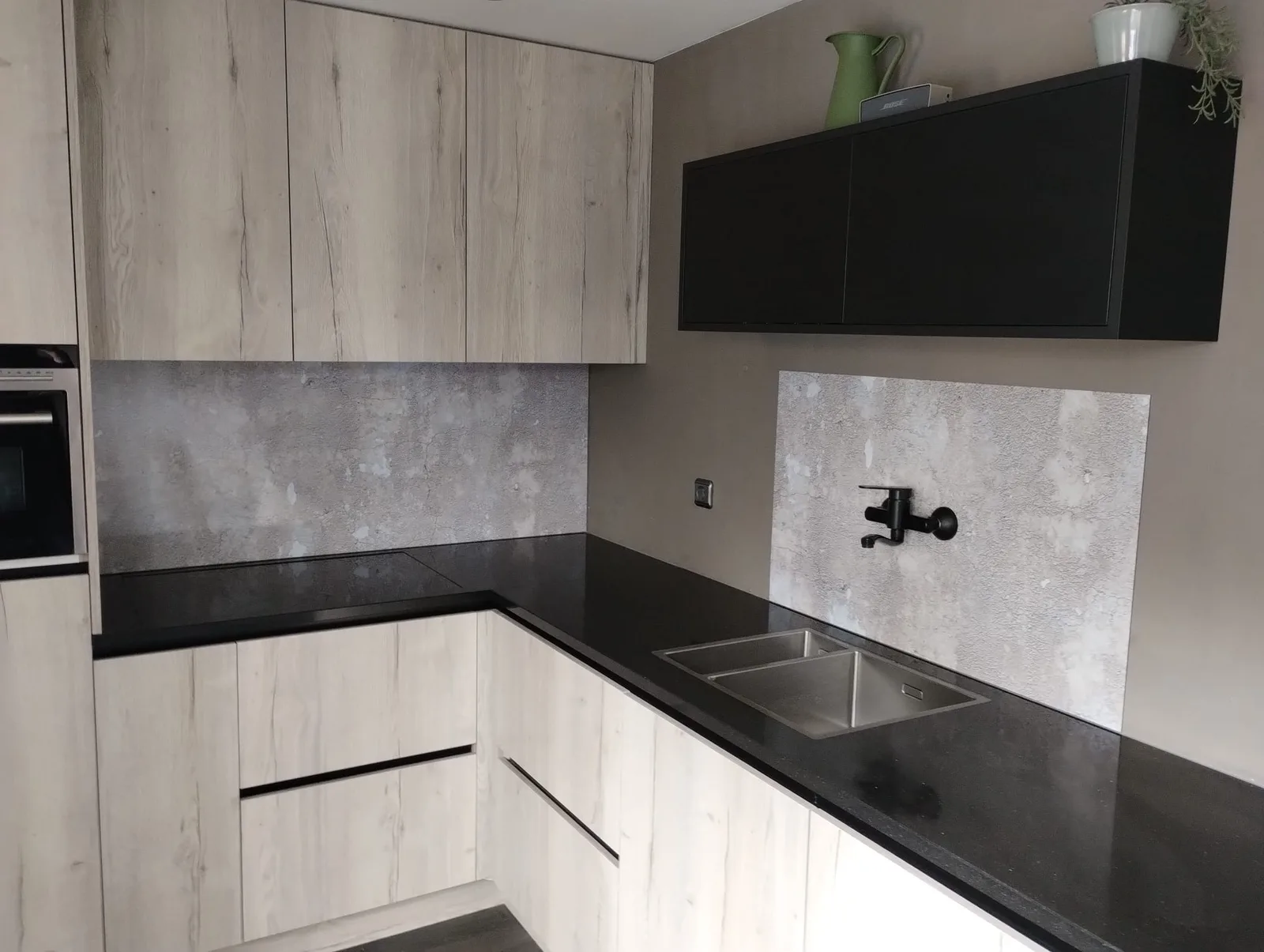
The classic choice. Mid grey with clouding and light patches gives the most character without dominating. Strong alongside wooden fronts and a dark worktop, exactly as in the photograph above. DW7372 is the most chosen design here.
Dark concrete look
Anthracite to almost black. This is the version that does something: it turns the wall into a backdrop and lets your kitchen come forward. It does need enough light, otherwise it quickly feels heavy. Look at DW7370 or browse the full concrete, tiles and stone collection.
Concrete look behind the hob and around the sink
This is exactly where real beton ciré struggles and a printed panel wins. Plaster is porous, even after sealing, and grease works its way in over time. A panel is a closed, continuous surface with no grout.
With induction or ceramic cooking our standard material DW Original is perfectly fine. If you cook on gas, keep at least 10 centimetres between the burners and the wall, or choose solid aluminium or tempered glass for more heat resistance.
Around the sink the continuous panel is the biggest advantage. Water running down a grout line becomes a mould problem eventually; water on a panel you simply wipe away.
Combining concrete look
Concrete is a neutral backdrop, which makes it easy to work with. Three combinations that hold up in practice:
- Concrete and wood. The classic. The warmth of oak or ash against the coolness of concrete. Works with both light and dark fronts
- Concrete and black. Black worktop, black taps, grey wall. Crisp and calm, and it hides marks well
- Concrete and marble. A marble worktop against a concrete wall creates tension without becoming busy, as long as you keep one of the two quiet
If you want something with more metal in it, have a look at a stainless steel look backsplash in brushed aluminium.
What does a concrete look backsplash cost?
A made to measure concrete look backsplash starts from around 100 euros with us for DW Original. The exact price depends on the dimensions, the material and the number of cutouts. You work it out yourself in the configurator by entering your measurements.
For comparison: have the same wall done in real beton ciré and with materials and labour you are quickly a factor five to ten higher, and that is before counting the days your kitchen is out of use.
Frequently asked questions about concrete look backsplashes
Is a concrete look backsplash the same as beton ciré?
No. Beton ciré is a hand applied plaster layer with real relief, laid by a plasterer and sealed after curing. A concrete look backsplash is a made to measure panel with a photograph of concrete printed on it. The image is almost identical, you cannot feel the texture, and the price difference is considerable.
Can a concrete look backsplash go over existing tiles?
Yes, in most cases. As long as the tiles are flat and well bonded, you can glue the panel straight over them yourself. That saves demolition and dust. Would you rather not? A local handyman is usually the cheapest option, and we are also happy to quote for installation: all we need is your postcode. With heavily textured tiles or loose ones, some preparation is needed. See the guide on fitting a kitchen backsplash for the details.
Is concrete look suitable behind a gas hob?
With at least 10 centimetres between the burners and the wall, DW Original is suitable. If the hob sits closer to the wall, or you cook intensively on gas, choose solid aluminium or tempered glass. Both take more heat.
How do I clean a concrete look backsplash?
With a soft cloth, warm water and if needed a mild detergent. Because there is no grout and the surface is closed, no grease is left behind. Do not use abrasives or aggressive cleaners, they attack the top layer.
Does a printed concrete look appear fake?
That depends on the image. A flat grey field gives itself away immediately. Our concrete designs come from photographs of real walls, with colour variation, hairline cracks and lime traces, and it is exactly that irregularity that convinces. If in doubt, order a sample first and hold it against your cabinet fronts.
Can I have my own concrete photograph printed?
You can. If you have a photograph of a wall you like, we can print it on your backsplash, provided the resolution is high enough for the size. If you are unsure, we will check it with you beforehand.
Further reading
- Concrete, tiles and stone collection. All concrete designs together, from white to anthracite.
- DW Original. The material most concrete look backsplashes are printed on.
- Fitting a kitchen backsplash. How to hang the panel yourself, including over existing tiles.
- Stainless steel look backsplash. If you would rather have metal than concrete.
- Brick backsplash. The rougher, warmer variant, also without porous grout lines.