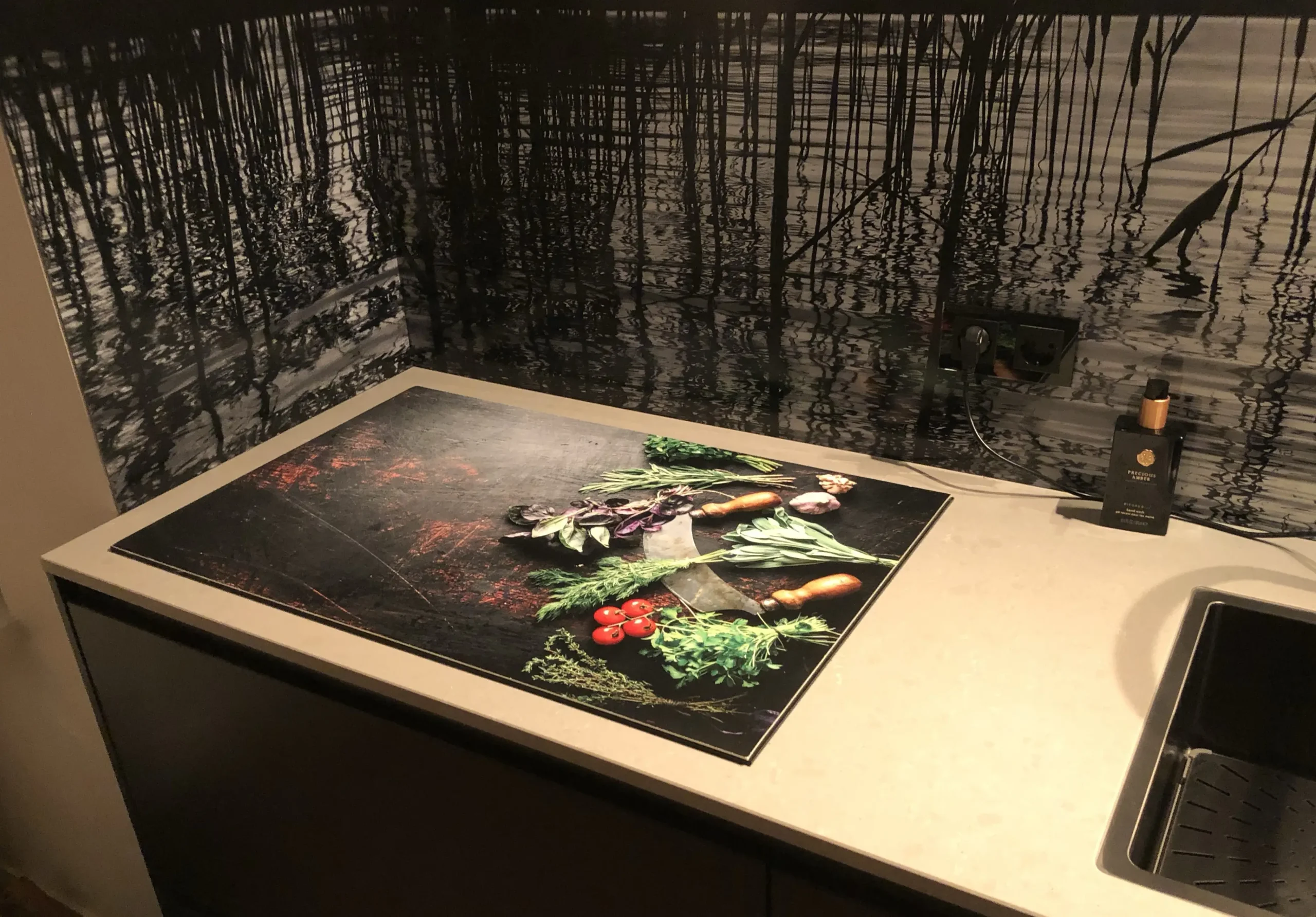
An induction hob is the largest glass surface in your kitchen, and for most of the day it does nothing. An induction hob protector turns it into worktop: you lay a printed mat over the glass, put your chopping board or shopping on it, and take it off as soon as you start cooking. Sounds simple, but the questions come quickly. What size do you need? Isn’t a silicone mat more practical? And can it stay on while you cook? Here is how it all fits together.
What an induction hob protector does, and what it doesn’t
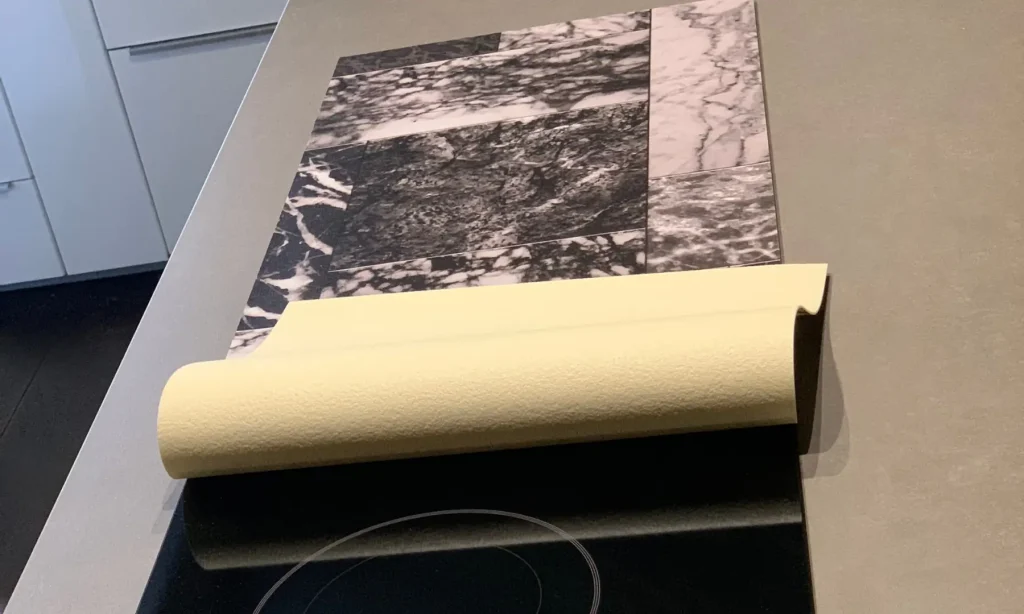
An induction hob protector is a mat that lies over your hob whenever you are not cooking. It does three things:
- It protects the glass. Against scratches from a pan you put down for a moment, against splashes and against dust.
- It gives you work space. In a small kitchen, a 60 or 80 cm hob is a sizeable piece of worktop you otherwise cannot use.
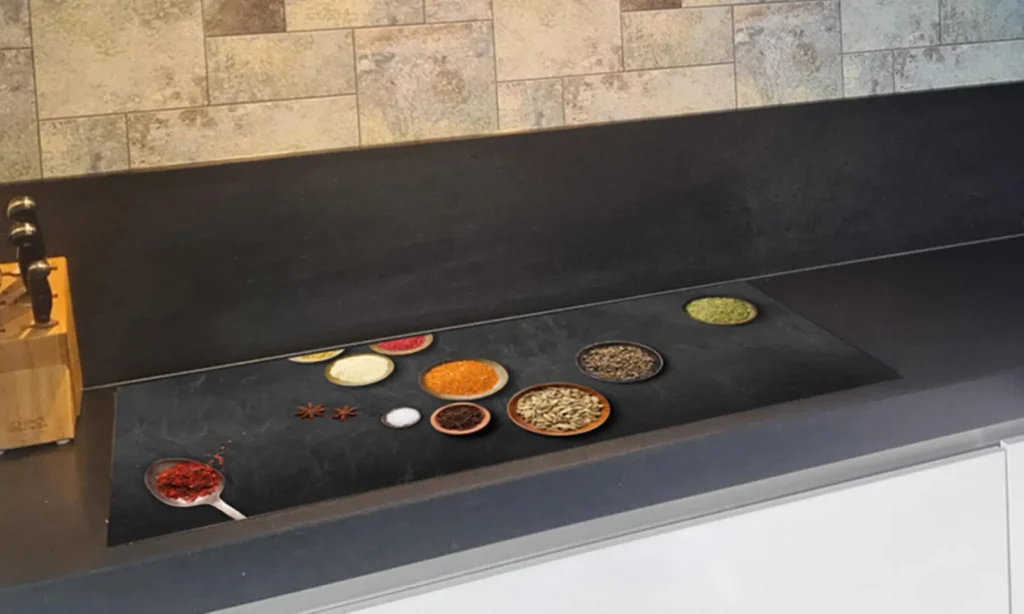
- It changes the look. Instead of a black surface with scratches and limescale rings, you see a marble print, a photo or a design that matches your backsplash.
What it is not: a trivet or a cooking mat. You do not put a hot pan or oven dish on it, and you cook without it. Why not is explained below.
What size do you need?
Measure the glass top, not the cut-out in your worktop and not the size from the brochure. A hob sold as “60 cm” is often 59 or 60 cm wide, and an 80 cm hob can be anywhere from 78 to 81 cm. The depth is 52 cm on most models. Take a tape measure, measure the width from left to right across the glass and the depth from front to back, and note them in whole or half centimetres.
That also explains the size questions we see a lot, such as 59 x 52 or 81 x 52 cm: those are simply hobs that are just off the standard. A made to measure protector takes care of that. There are fixed sizes for the common hobs, and for everything else you enter your own width and depth:
| Hob | Protector size |
|---|---|
| 60 cm wide | 60 x 52 cm |
| 70 cm wide | 70 x 52 cm |
| 80 cm wide | 80 x 52 cm |
| 90 cm wide | 90 x 52 cm |
| Any other size | each side from 20 to 500 cm |
A few things to watch when measuring:
- Controls at the front or side. If the touch controls are on the glass, they will be under the protector. Switch on the child lock before you lay it down, so a tap or a heavy bag on the mat cannot turn the hob on.
- Hob with a frame. If your hob has a stainless steel frame or a bevelled edge, measure the flat glass inside that edge. A mat will not lie flat on a raised rim.
- Hob with a built-in extractor in the middle. The protector simply runs over it. Keep the extractor switched off while it is in place.
Printed mat, silicone or glass: the materials compared
Very different products are sold as an “induction protector” or “hob cover”. Broadly there are three kinds, and they do not do the same job.
| Printed mat | Silicone mat | Glass cover plate | |
|---|---|---|---|
| Purpose | Covering and work space when you are not cooking | Mostly covering, some are meant to sit under the pan while cooking | Covering, as a rigid extra worktop |
| Size | Made to measure, to the centimetre | Standard sizes, cut to size yourself | Standard sizes |
| Look | Fully printed, any design or your own photo | Plain or a simple pattern | Plain or lightly printed |
| Storage | Roll up or lay flat | Roll up or fold | Flat, and heavy |
| Watch out | Do not leave it on the hob while cooking | Stick to the manufacturer’s maximum temperature | Glass on glass scratches if a grain gets between |
Our induction protector is a printed mat with a non slip backing. The material is heat and scratch resistant and water repellent, so a wet tea towel or a dish straight from the fridge is no problem. The advantage over silicone is mainly the size and the print: you get a surface that fits your hob exactly and looks the way you want.
Can it stay on while you cook?
No. You take a printed induction protector off as soon as you start cooking, exactly the way you would remove a placemat before putting a hot pan down.
The idea that it can stay on comes from how induction works. The cooking zone itself does not heat up: the magnetic field heats the base of the pan. But that pan does get hot, and the heat goes straight down into the glass. Whatever lies between pan and glass gets the full temperature of the pan base. When frying or stir-frying, that is far more than a printed mat should get.
There are thin silicone or fibreglass mats that are designed to sit under the pan, to prevent scratches while cooking. That is a different product with a different purpose. If you use one, check the maximum temperature the manufacturer gives, and bear in mind that some hobs detect a pan less reliably with a layer in between.
After cooking, you put the protector back. The residual heat of an induction zone you have just switched off is limited, because the glass was only warmed by the pan. If you want to be completely sure, wait until the residual heat indicator (usually an H in the display) has gone out.
Induction or ceramic: does it matter?
Not for the protector itself: it fits any flat glass hob, so ceramic and vitroceramic hobs too. The difference is in the heat after cooking. A ceramic hob heats the glass itself, and that stays hot for quite a while after you switch it off. On a ceramic hob, only put the protector back once the residual heat indicator has gone out. On an induction hob that happens much sooner.
It does not work on a gas hob with separate burners and pan supports: a mat will not lie flat or stable there. If you cook on gas and want to protect the wall behind it, read which backsplash you can use behind a gas hob.
Make one yourself or have it printed to size
You can make a simple protector yourself. Cutting a silicone baking mat or a piece of silicone table mat to size is the quickest route. A wooden board works too, as long as the underside is smooth and you stick felt or rubber underneath. When making your own, pay attention to three things:
- The underside must be soft and clean. Anything hard, or anything that holds on to sand, will scratch the glass as you slide it back and forth. That is exactly what you wanted to avoid.
- It must not slide. A mat that slips away while you are cutting on it is a risk. A non slip underside prevents that.
- It comes off when you cook. A homemade version is also a cover, not a cooking mat.
What you cannot do at home is print across the whole surface. If you want a marble look, a photo or a design that suits your kitchen, have it printed. A made to measure induction protector also comes in the exact size of your glass top, even when it is just off the standard.
With your own photo or a design
You make an induction protector with your own photo in the configurator: enter your size, upload your photo, then drag and zoom until the image sits well within the surface of your hob. The configurator warns you if the resolution is too low for a sharp print. A photo from a recent smartphone is more than enough for a 60 or 80 cm hob.
A few tips for a photo that works well on a hob:
- Choose a landscape photo. A hob is wider than it is deep, at 80 x 52 cm more than one and a half times. A portrait photo has to be cropped heavily.
- Calm beats busy. Things will be put on it. A landscape, a texture or a large detail stays beautiful, a group photo with ten faces disappears under the chopping board.
- Look at your backsplash. A protector in the same design as your kitchen backsplash makes hob and wall one whole. Still looking for a backsplash? The kitchen backsplash guide helps you choose. Behind an induction hob, DW Original is suitable in almost every case.
No image of your own? Then pick a design from the collection. One of our designs costs the same as your own photo. If you are unsure, a calm pattern such as the marble look DW7346 is a safe choice: it suits almost any kitchen. Before we print, you always receive a digital proof for approval first.
Cleaning and storage
Clean it with a damp cloth. Do not use a scouring pad or harsh cleaner, as they damage the print. Wipe the hob itself as well before you put the protector back: a crumb or grain of sand between mat and glass is the only thing that can still cause scratches.
While you cook, lay it flat on the counter or roll it up loosely. Do not fold it, because a crease stays visible in the print.
Frequently asked questions
What size induction hob protector do I need?
Measure the glass top of your hob, not the cut-out in the worktop. Most hobs are 52 cm deep and 60, 70, 80 or 90 cm wide. If yours is slightly different, for example 59 x 52 or 81 x 52 cm, simply order that size: each side can be anything from 20 to 500 cm.
Can an induction hob protector stay on while cooking?
No. A printed induction protector is meant for the times you are not cooking. When you start cooking, take it off. A pan that has just come off the heat does not belong on it either.
Does an induction protector also work on a ceramic hob?
Yes, as long as the surface is flat. A ceramic hob does stay hot for longer after cooking than an induction hob, so wait until the residual heat indicator has gone out before you put the protector back.
Can I have an induction protector made with my own photo?
Yes. You upload your photo in the configurator, drag and zoom it within your hob size, and see straight away whether the resolution is good enough for a sharp print. Your own photo costs the same as one of our designs.
How do I clean an induction hob protector?
With a damp cloth. Wipe the hob itself as well before you put the protector down, so no crumbs or grains of sand end up between the glass and the underside.
A protector made to fit your hob
Pick one of the fixed sizes or enter your own, and finish it with a design from the collection or your own photo.