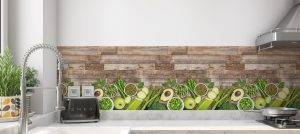
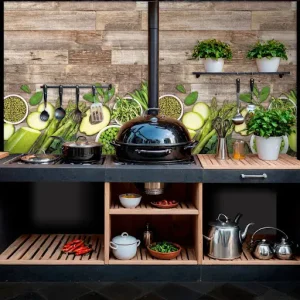
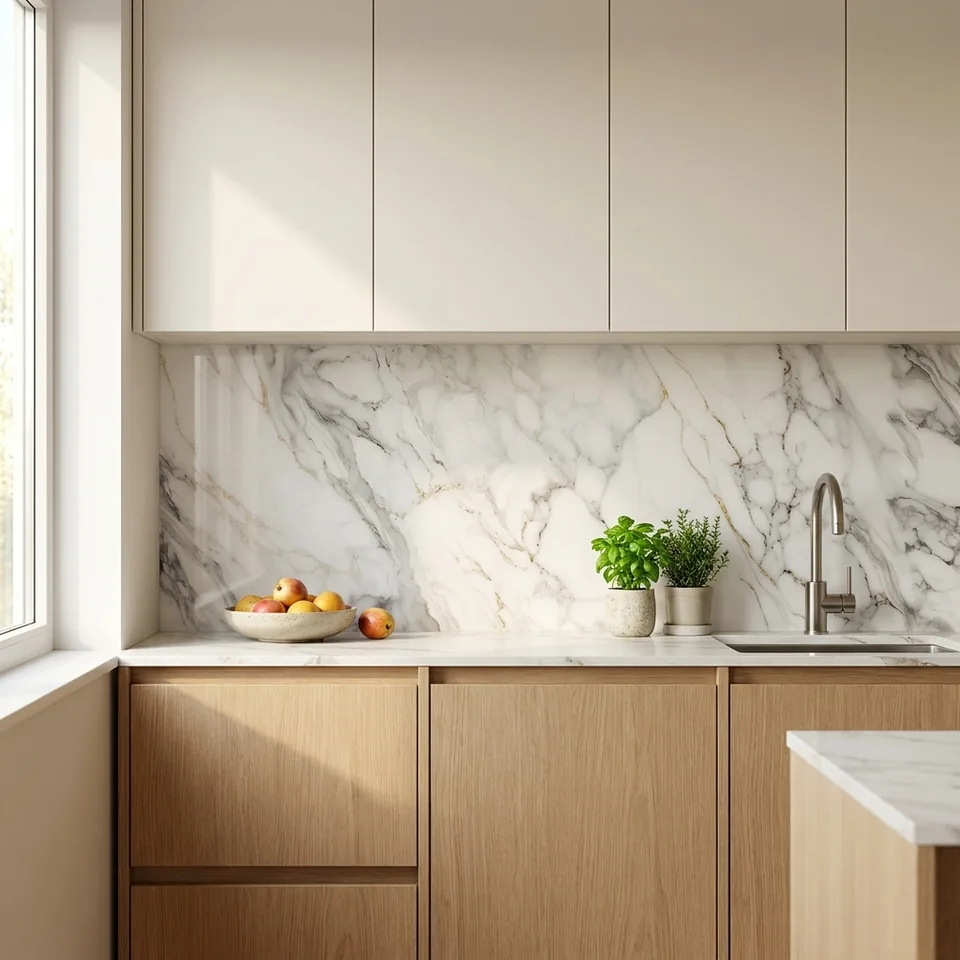
Green is the colour that calms a kitchen down without making it dull. Sage and olive sit well with wood and white, deep green marble turns the backsplash into the eye-catcher of the room, and green tiles give a kitchen exactly the bit of character that plain fronts lack. In this article we go through the shades one by one: which green kitchen backsplashes we have, which kitchens they suit and how to judge the colour before you order. Every one is a single made-to-measure panel without grout lines, which you put together yourself in the backsplash configurator.
Why green works so well in the kitchen
A kitchen is usually made up of large surfaces in one colour: white, grey, black or wooden fronts, a worktop and a wall. Green is the natural counterpart to all of those materials. It sits next to oak without clashing, it softens a black kitchen and it gives a white kitchen depth. And unlike a bright colour, green stays calm: the muted shades, with grey or brown mixed in, are colours you will still not be tired of years from now.
The big advantage of a green backsplash is that you do not have to change anything else for it. The fronts, the worktop and the floor stay as they are. You put one block of colour behind the worktop, and the whole kitchen looks different. If you have gone off it in ten years, you only swap the panel.
Shade by shade: which green backsplash suits which kitchen
Sage and olive: soft and warm
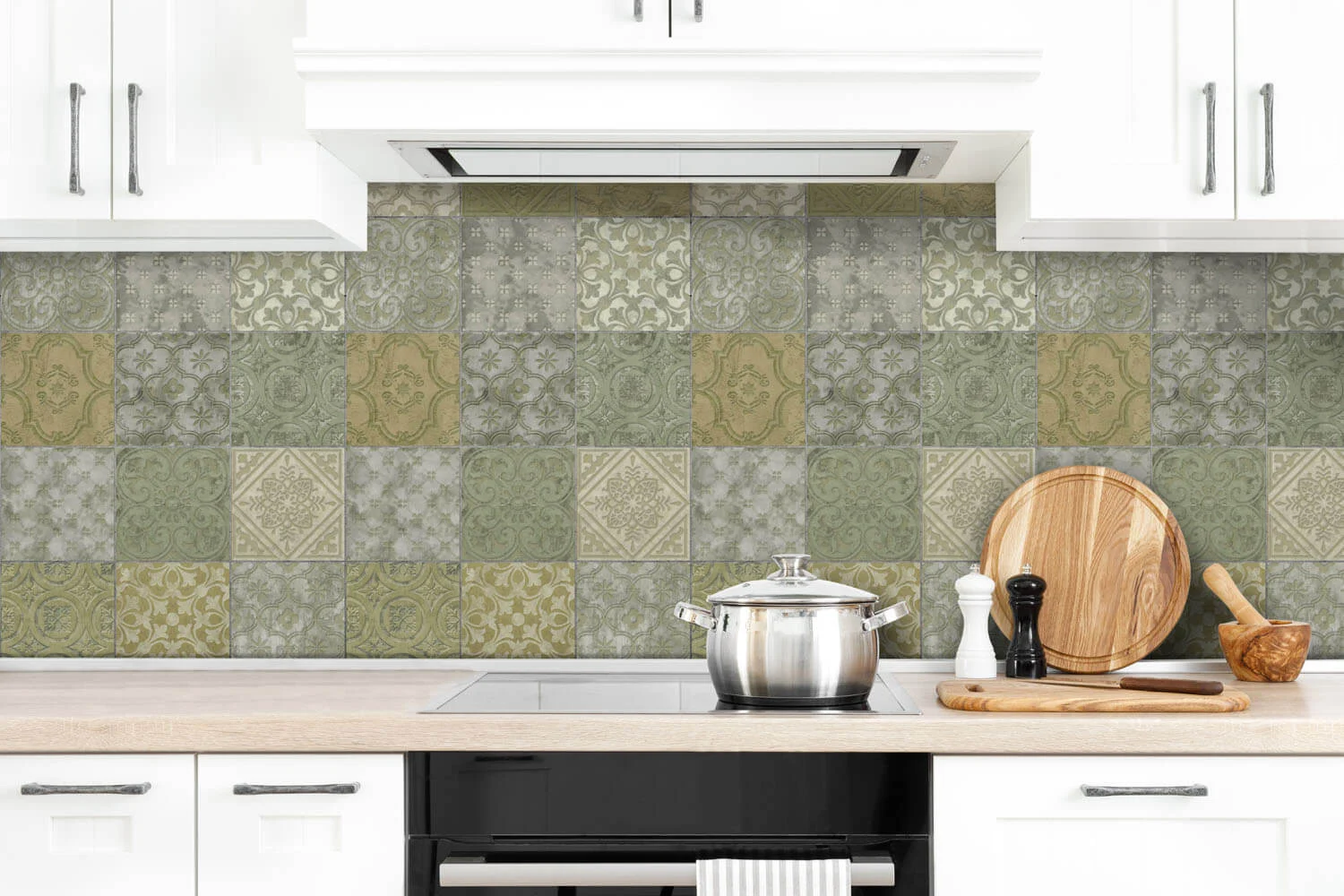
Sage green is the shade people have asked for most in recent years, and with good reason. It is light enough for a small kitchen and warm enough to sit next to wood. Our green patterned tile shows weathered decorative tiles in olive green, sage green and moss green, with classic floral and arabesque motifs. From a distance it reads as a calm green surface, up close you see the pattern. That works well above a wooden worktop and with white or sand-coloured fronts.
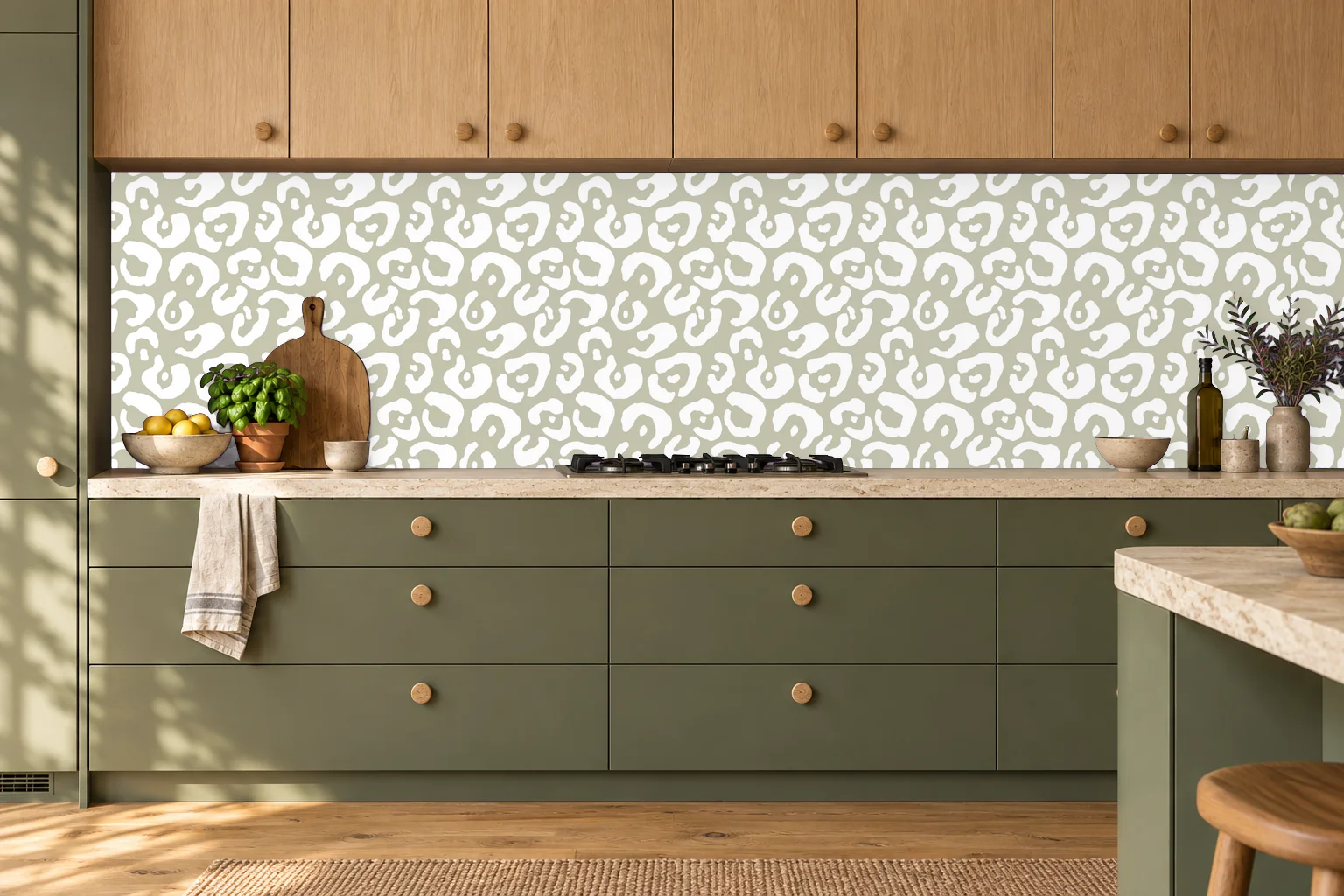
If you want sage without a tile motif, there is the leopard print in sage: a fine, almost tone-on-tone print that reads as a texture. And if you want a plain green, you choose a RAL colour. More on that further down.
Green marble: the eye-catcher
Green marble is the opposite of sage: dark, glossy and full of veining. It is the choice for anyone who sees the backsplash as the centrepiece of the kitchen. Green Marble DW8615 shows deep green marble with white veins, one of our most popular designs. Green Marble DW8617 is greyer, with horizontal, layered bands, and therefore calmer. Both look their best with light fronts and with brass or black handles. You will find more marble designs in the marble category.

With marble, pay attention to the scale of the veining. On a narrow strip behind the hob you only see a small part of the pattern; on a wall of three metres the whole vein comes into its own. So order a sample first and hold it up where the backsplash will go.
Green tiles: zellige, antique and stained glass
Green tiles are the third route, and this is where the choice is widest. The antique tile Green Teal shows olive, sage and moss green tiles with a weathered, glaze-like surface, like handmade tiles where every tile turns out slightly different. The stained glass in green is bolder: arabesque tile shapes in deep green, turquoise, ochre gold and blue. And in the antique tiles category there are even more green and blue-green variants, from herringbone to block tiles.
The difference from real tiles: no grout lines, so no grease in the joints and no mould. All the tile designs are a print on a single panel, which you fit over your existing wall or tiles. How that works is explained in our article on the tile look without real tiles.
Plain green: a RAL colour
If you want a single colour rather than a print, you choose a backsplash in a RAL colour. Looking for a soft plain green without a RAL number? Take a look at Texture Celadon, a plain design in soft sage green with a fine textile texture. You give us the RAL number and we print that colour on the panel. For green, RAL 6021 (pale green), RAL 6011 (reseda green) and RAL 6009 (fir green) are popular shades, but any number is possible. How to choose a RAL colour and how to request samples is explained in our article on RAL backsplashes.
Combining with fronts, worktop and floor
- White kitchen. Anything goes. Sage and olive make the kitchen warm, green marble makes it luxurious. Keep the handles in the same family: black or brass with marble, black or stainless steel with sage.
- Wooden kitchen. Oak and sage are a classic combination. Deep green marble can work too, but only with light wood; with dark wood it becomes too heavy.
- Black kitchen. Green marble with white veins gives the contrast a black kitchen needs. Sage turns greyish against black, so go for olive instead, or a tile design with a bit of warmth in it.
- Grey kitchen. Grey and green are close to each other. Choose a green with clearly more colour than the front, otherwise the surfaces blur into one another.
- The floor. A warm wooden floor suits all the shades above. With a cool grey resin floor, a blue-green or petrol works better than olive.
Which material do you choose?
Every design in this article is available in three materials. DW Original is a 3 mm aluminium composite panel: light, can be glued over existing tiles and the most popular option with induction and ceramic hobs. DW Solid is 1.5 mm solid aluminium, for behind a gas hob or next to an air fryer that vents to the back. DW Glass is toughened glass: the most depth in the image, and with green marble it comes closest to the sheen of real stone. If you cook on gas, read our article on a backsplash with a gas hob first.
A backsplash is made to measure, including cut-outs for sockets, and costs from 150 euros. You enter the measurements in the configurator; how to measure is explained in our measuring guide.
Judging green: screen, light and sample
With green in particular, the difference between screen and reality is big. Sage looks grey on one phone and mint on another, and deep green marble turns bluer under cool LED light than in daylight. So always order a 20 x 20 cm sample first. You then see the design, the sheen of the top layer and the colour in your own light, in the spot where the backsplash will go. If you want to see how the whole wall looks in your kitchen, send in a photo of your kitchen via the simulation service and we will place the design in it.
Frequently asked questions about a green backsplash
Which green suits a white kitchen?
Almost every shade, because white does not fight back with a colour of its own. Sage and olive make a white kitchen warm and calm, green marble makes it luxurious. Choose the shade based on your worktop: with wood, sage or olive; with a white or grey worktop it can go darker.
Does green go with a wooden worktop?
Yes, it is one of the easiest combinations. Sage and olive sit next to oak and other light wood without clashing. Deep green marble works with light wood too; next to dark wood it quickly becomes too heavy, so choose olive or a tile design with some warmth in it instead.
Will green marble behind the hob look too busy?
That depends on the size of the wall. On a 60 cm strip behind the hob you only see part of the vein and it can look restless; on a whole wall the pattern comes into its own. If in doubt, choose DW8617 with its calmer, layered veining, or request a simulation.
How do I know whether the colour matches my screen?
Not via the screen. Order a 20 x 20 cm sample and look at it where the backsplash will go, in daylight and under your kitchen lighting. Green shifts more than most colours, so this is the step you should not skip.
Green on your kitchen wall
We make every design to the size of your wall, including cut-outs. Order a 20 x 20 cm sample first, so you can see the colour in your own light.