Herringbone tiles in the kitchen belong to that group of patterns which never really go away. You see it in hundred year old Parisian parquet floors and in new build kitchens fitted last month. As a kitchen backsplash it works for a reason that is often overlooked: the pattern gives direction to a surface that would otherwise be empty, without you having to commit to a colour or a motif.
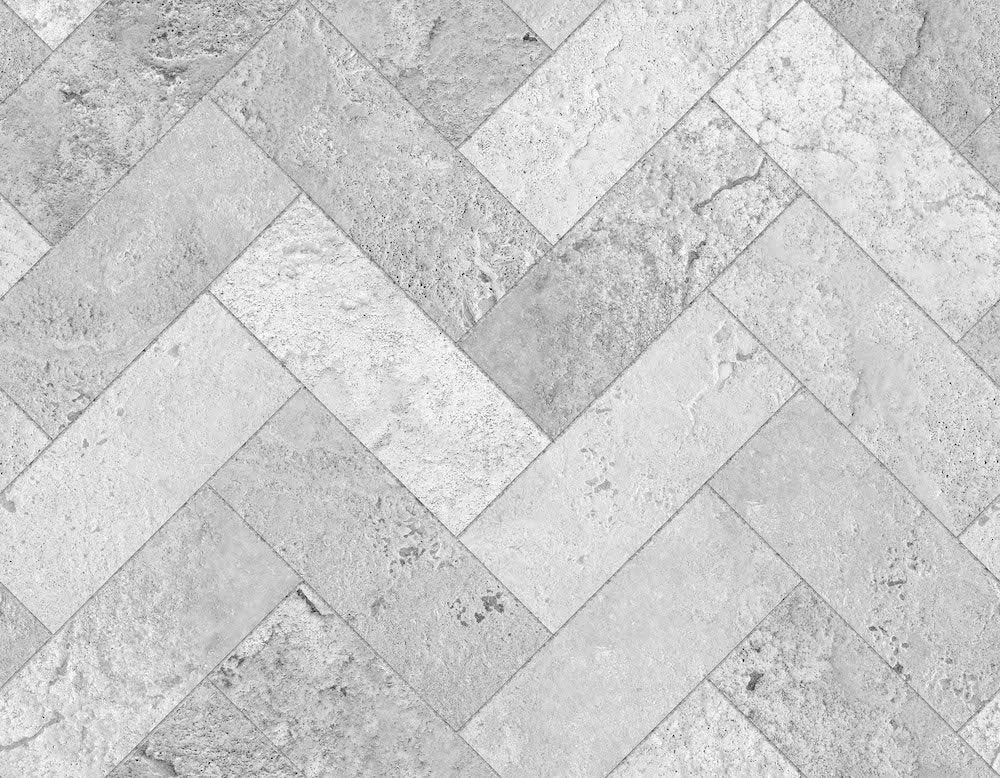
Herringbone, chevron or brick bond: what is the difference?
These three are constantly confused with one another, in webshops as well. The difference lies in how the tiles meet.
- Herringbone. Rectangular tiles set at right angles to one another. The end of one tile butts against the long side of the next, which produces a stepped zigzag
- Chevron. The tiles are cut at an angle and meet end to end. That gives a continuous V with no steps. Cleaner, and rather more formal
- Brick bond. Straight rows, each row offset by half a tile. Calmer, less pronounced
For a kitchen wall, herringbone is usually the safest of the three. Chevron asks for a room that is squarely aligned, because every out of true corner shows. With herringbone that disappears into the pattern.
Why a printed herringbone backsplash and not real tiles?
Laying a herringbone pattern in real tiles is precision work. Every tile has to sit exactly square, because half a degree out of true builds up along the length of the wall. Reckon on a tiler, two days of work, and a price to match.
With a herringbone kitchen wall or backsplash the pattern is in the print. It is one continuous panel, cut to your measurements, that you hang in an hour. The pattern is guaranteed to run straight, because it is already printed on.
The practical advantage only becomes clear after a year or two: no grout. Because of all those short edges, a herringbone wall has roughly twice as much grout length as brick bond. Behind a hob that is exactly that much extra space for grease to work into and for you to get at with a brush. A printed panel you wipe clean in one movement.
Which herringbone colour suits your kitchen?
Grey herringbone
The most chosen of all herringbone tiles for the kitchen, and the most forgiving. Grey herringbone shows the pattern without the colour having a say, and that makes it work with almost any cabinet front. See DW8530 herringbone tile in grey.
Beige and warm shades
Warmer, and welcome alongside wooden fronts or in a light kitchen that would otherwise feel clinical. Have a look at the beige version.
Green, blue and dark
If you want the wall to really do something, a coloured herringbone is a good way to add colour without ending up with a flat wall of it. The pattern breaks the colour up, which makes it less heavy than the same green or blue laid on plain. Browse the patterns and stripes collection for the full choice.
Herringbone in a small kitchen
There is a stubborn idea that a pattern makes a small room smaller. With herringbone it often works the other way round, as long as you watch one thing: the direction.
If the zigzag runs horizontally, it draws the eye along the wall and your kitchen looks wider. If it runs vertically, the wall seems higher, which helps under a low ceiling. In both cases the same rule applies: the smaller the tiles in the pattern, the calmer the whole. A coarse herringbone pattern in a narrow kitchen quickly becomes busy.
Frequently asked questions about herringbone backsplashes
Are they real tiles or a print?
A print. The herringbone pattern is printed at high resolution on a continuous panel, including the shadow lines between the tiles that give it depth. From half a metre away you cannot tell it from real tiling. What you do not get is the relief of real grout, and that is precisely why it is so easy to clean.
Can a herringbone backsplash go over existing tiles?
Yes, if the existing tiles are flat and well bonded. The panel is glued straight over them with adhesive. That saves demolition and a day of dust in the house. With heavy relief or loose tiles, some preparation is needed. See the guide on fitting a kitchen backsplash.
Does the pattern run across the whole wall?
Yes. Because we print to your measurements, the pattern is carried across the full width. There is no repeat that you suddenly see jump, and there are no seams where two panels meet, unless your wall is wider than the maximum panel width. In that case we agree beforehand where the seam will show least.
Is herringbone suitable behind a gas hob?
The pattern makes no difference there, the material does. With induction or ceramic cooking, DW Original is enough. If you cook on gas, keep at least 10 centimetres between the burners and the wall, or choose solid aluminium or tempered glass.
Can I have the colour of the herringbone pattern adjusted?
Often we can. If you like the pattern but not the colour, let us know through contact and quote the design code. We will then look at whether we can shift the shade to something that suits your kitchen.
Further reading
- Patterns and stripes collection. All the herringbone, chevron and geometric designs together.
- Kitchen backsplash: the complete guide. Materials, sizes and fitting, for when you are still getting your bearings.
- Concrete look backsplash. If you would rather have a calm surface than a pattern.
- Fitting a kitchen backsplash. Hanging it yourself, over existing tiles too.